


This is Part 3 of 3. Start with Part 1 here, and go to Part 2 here.
Leon has a habit that used to drive me a little crazy.
Every time our group made a plan (a trip, a project, a big decision), Leon would pause right before we all agreed and say, “Hang on. Let me think about whether this is a good idea.” Every single time. At first it felt like he was pumping the brakes for sport. But after a while I noticed something: Leon was almost never the one who had to walk back a decision. He’d already done the walking.
I eventually asked him about it. He just shrugged and said, “I’ve been wrong enough times that I stopped trusting my first instinct.”
That’s not low self-esteem. That’s wisdom. And it’s also, I’ve come to think, a pretty good window into the third command in Micah 6:8.
Walk humbly with your God.
We’ve been working through all three commands in this verse — act justly, love mercy, and now this one. “Walk humbly” can sound like “be nice and don’t brag.” But there’s more going on here.

What the Hebrew Actually Says
The word translated as “humbly” is tsana (צנע), and it’s rare. It only shows up twice in the entire Hebrew Bible. That alone should make you pay attention. It doesn’t just mean “low” or “submissive.” It carries the sense of being careful. Circumspect. Genuinely aware of your actual place in things.
The word for “walk” is halak — a common Hebrew verb that meant not just movement but the direction of your whole life. In the ancient world, how you walked described who you were.
And then there’s the little word “with.” Not before God, like you’re standing in a courtroom. Not for God, like it’s all a performance. With. Alongside. In genuine company.
Put it together and you get something like: move through your whole life with honest self-awareness, in real relationship with the One whose perspective on reality is a little more complete than yours.
(Which, when you put it that way, seems like the smart play.)
This Isn’t About Thinking Less of Yourself
Before we go further, I want to pump the brakes on one version of humility that I don’t think is what Micah had in mind.
You’ve probably met someone who can’t accept a compliment without deflecting seventeen times or who turns every conversation back to how inadequate they are. That’s not humility. That’s actually a different kind of self-obsession.
C.S. Lewis said a humble person wouldn’t make you think less of them — you’d barely think about them at all, because they’d be too busy thinking about you.
Biblical humility isn’t self-erasure. It’s self-accuracy. It’s knowing what you’re good at and what you’re not. It’s holding your opinions with an open hand instead of a death grip. It’s the ability to say “I was wrong about that” without treating it as a personal catastrophe.
It’s not a personality type. It’s a posture. And the good news is, postures can be learned.
Why This One Is Last — And Why That Matters
I don’t think the order of these three commands is accidental.
Act justly and love mercy are both outward-facing in that they describe how you treat other people. They’re demanding, and they matter enormously. But they share a common danger: they can slowly become about you.
I’ve watched it happen in others and, if I’m being straight with you, in myself. Someone starts doing good, consistent justice work, and after a while a kind of hard edge sets in. They stop being able to imagine they might be part of the problem. Their advocacy starts to feel less like service and more like a verdict. Justice without humility curdles into self-righteousness.
Mercy can do the same thing. The person who extends kindness in a way that subtly reminds everyone how kind they’re being — that’s not really mercy. That’s charity with a mirror in one hand.
Walk humbly with your God is the foundation that keeps the other two from going sideways. When you genuinely believe that you yourself have needed mercy (that you live by grace, not by being the good one in the story), justice stops being a platform and becomes just what you do. Mercy stops being a favor and becomes something you give because it was given to you.
The humility isn’t the add-on. It’s what makes the other two work.

The “With” Is the Whole Thing
Now, let’s come back to that little preposition.
My dad said grace before every meal. Same prayer, roughly, every night for as long as I can remember. “God is great. God is good. Let us thank Him for our food. Amen.” Except for his stint in the Army when he was deployed during wartime and he prayed, “Rub-a-dub-dub. Thanks for the grub. Yeah, Lord! Amen.” Either way, grace was twenty seconds, tops. Then it was time to eat.
I didn’t think much about it growing up. It was just dinner. But the first time I sat down at a restaurant as an adult and didn’t say anything, just picked up my fork and dug in, I felt this odd little tug. Not guilt exactly. More like I’d walked into a room and left the door open behind me.
I mentioned it to my dad later. He didn’t laugh. He said, “That feeling is right. You’re not supposed to be comfortable forgetting.”
He wasn’t talking about table manners. He was talking about orientation. About the practice of locating yourself in relation to God before you do anything else.
That’s what “with” means in Micah. It means God is actually there. Not waiting at the end of a long religious to-do list, but here, alongside you, in the middle of a regular Tuesday. The relationship is real, not ceremonial
He says with. And that changes the whole texture of what a faith life is supposed to feel like.
What Micah Was Actually Talking Into
It helps to remember that Micah was writing a rebuke for people who were very religious.
Eighth-century BC Israel had no shortage of temple attendance. Offerings. Sacrifices. All the external trappings. What they’d apparently lost was any real relationship with the God they were supposedly worshiping. Their religion had become transactional: do the rituals, secure the favor, go home and keep running the system that was grinding the poor into dust.
Walk humbly with your God was a direct challenge to exactly that kind of religion.
It’s not saying: go to the right services. It’s not saying: check the right boxes. It’s saying: actually know God. Let that relationship be the thing that shapes you from the inside, not just something that manages your reputation from the outside.
Their problem wasn’t lack of religion. It was religion without humility. No genuine sense that they were dependent. That they’d been shown mercy. That the grace they’d received was supposed to change how they treated other people.
That’s still a live danger. I’d argue it always will be.
What It Actually Looks Like
If act justly and love mercy describe what you do, walk humbly with your God describes who you’re doing it as.
In practice, it looks like holding your opinions loosely enough to change them when you encounter a better idea. It looks like saying “I was wrong” without requiring someone to drag it out of you. It looks like staying curious about what God might be doing in a situation instead of assuming you already have it figured out.
It also means letting God’s call to act justly and love mercy correct your “side” when it needs correcting. Creator > created. And it looks like not needing to be the most important person in the room — or to win the argument.
And practically speaking: it looks like actually praying. Not as a quick formality before the “real” part of your day starts, but as a way of staying connected. Bringing your actual life (the messy, ambiguous, still-being-figured-out version of it) into God’s presence — not the cleaned-up Sunday version.
The difference between religious performance and honest relationship is that performance has an audience of many. Honest relationship only has one.
The Whole Picture
We’ve walked all three commands now.
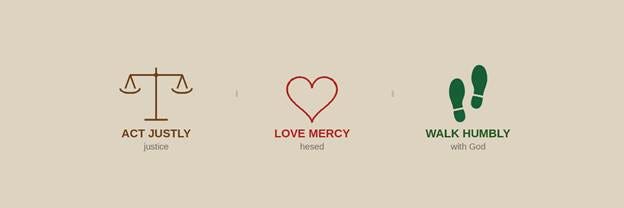
Act justly: do right by people in the real, concrete world, even when it costs you something.
Love mercy: let hesed — that loyal, tenacious, steadfast love — be the spirit underneath how you treat people.
Walk humbly with your God: stay honestly oriented to your actual place before God, in real and ongoing relationship with him.
They belong together. Each one does something the others can’t do alone. Justice without mercy is cold. Mercy without justice is soft. Both without humility eventually become about you. And all three, when pursued without a real walk with God, will eventually lead to you running out of fuel.
Micah 6:8 isn’t a checklist. It’s a portrait of a person. A person who moves through the world doing right, extending love, and staying honest about who they are and who God is.
Like my dad, I say grace before meals. It reminds me whose world this is, who I am in it, and that I’m not walking alone.
That’s the invitation in those five small words: walk humbly with your God.
Not a reputation to manage. Not a checklist to complete. A life to live — with justice, with mercy, and with the kind of honest humility that comes from knowing who’s beside you.
Humility isn’t thinking less of yourself. It’s thinking about yourself less — and about God more.
For Further Reflection
As you act justly and love mercy, where are you most tempted to make it about you, and what would it look like to do the next right thing while walking humbly with God?
This is Part 3 of a three part series on the three commands in Micah 6:8. Part 1 is on acting justly “Legal Isn’t the Same as Just,” and Part 2 is on loving mercy “More Than A Feeling.”
Harvey all your posts feel like an invitation not a lecture. They are challenging for me to read. I have become complacent in my own walk with God. Thank you for calling me to a higher love.
So good! Most tempted to make it about me when I want to be noticed or thanked for my work. I will remember this in those times:
"The difference between religious performance and honest relationship is that performance has an audience of many. Honest relationship only has one."
Thank you, Harvey!