


Once early in my career, I was in court waiting for a hearing to be called. The gallery was crowded, the way it always is in busy urban courtrooms: a long row of people who had gotten there early, organized their papers, and were now sitting with the particular stillness of people who know they are invisible until their name is called.
A young woman two rows ahead of me was struggling to keep her composure. I could see it in her shoulders, the way she kept straightening in her seat, smoothing her papers, checking the door. At one point a clerk walked briskly past the gallery and the woman half-rose, hand lifted slightly, about to say something. The clerk didn’t slow down. Didn’t glance over. The woman sat back down and looked at her hands.
Nobody in that room saw that moment except me. And I have to be honest: I almost didn’t either. I was reviewing my own notes. I caught it in my peripheral vision and then almost let it go, the way you let go of most things that don’t require anything of you.
The God of Scripture would have seen it. He always does.
The Name She Gave Him
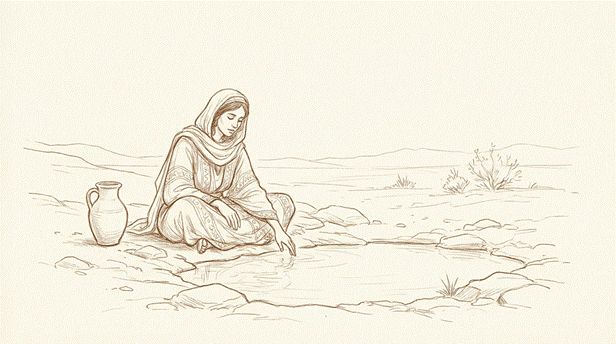
Hagar didn’t arrive at her theology in a classroom. She came to a spring in the wilderness, alone, pregnant, a foreign slave woman who had been used and then cast out. She was not someone the ancient world considered worth seeing.
And yet the text records something remarkable. She gave God a name no one had used before: El Roi, the God who sees me. (Genesis 16:13)
She didn’t say the God who redeemed me, or delivered me, or sent armies on my behalf. She said: the God who sees me. As if being seen, fully, without flinching, without the instinct to look away, was itself a form of grace. As if invisibility had been the wound, and being witnessed was the beginning of healing.
The Pattern of Divine Sight
Hagar’s story isn’t the exception. It’s the introduction to a pattern that runs through the entire Bible.
Isaiah 59 describes a society where courts are corrupted, the innocent can’t find justice, and truth has been suppressed. Then God’s response: ‘The Lord looked and was displeased that there was no justice. He saw that there was no one... and he was appalled that there was no one to intervene.’ (Isaiah 59:15-16)
Appalled is not mild disappointment. It’s the word of a witness shaken by what he cannot stop looking at. And what appalled him was not only the injustice itself, but that no one was doing anything about it. God scanned the room, and found no one paying attention.
Then there’s Jesus in the Temple courts, watching. A poor widow drops two small coins into the treasury. Jesus saw her, called his disciples over, and made them look. ‘Truly I tell you, this poor widow has put more into the treasury than all the others.’ (Mark 12:43) He made them see what the religious system had trained them to overlook. Seeing, for Jesus, was never a private act. It was an assignment he handed to others.
Seeing as an Act of Justice
There’s a theological claim embedded in these stories that doesn’t get said often enough: to be seen by God is to be dignified by God. The widow matters not because the institution acknowledged her, but because God turned his full attention on her. Hagar is not a footnote because God witnessed her. The young woman in that courtroom gallery is not invisible because she exists in the sight of a God who notices half-risen hands.
Divine sight is not neutral observation. It is a form of advocacy. To be truly seen, without minimization and without the instinct to change the subject, is to have your humanity affirmed. It is no accident that the most isolated and discarded people in these stories are the ones God sees most clearly. That’s not a coincidence. That’s a character trait of God’s.
Do You See What God Sees?
Last week’s article was about hearing. This one is about seeing. And the uncomfortable truth is that they fail the same way.
If we can engineer ways to help without truly hearing anyone, we can also learn to look without really seeing. We can become skilled at the courtroom-clerk version of presence: physically in the room, functionally somewhere else.
We drive through struggling neighborhoods on the way to somewhere else and call it awareness. We scroll past photographs of suffering in distant places like Israel, Gaza, Iran and the Ukraine, and call our reactive pause empathy. We call ourselves a loving church but decline to mobilize to advocate for the parts of our local community afflicted by racial tension, police brutality, or food insecurity. We sit in the same congregation as someone whose life is quietly falling apart and call the weekly social hug community.
And then there are the larger things. The ones that are harder to look at because looking might require something of us.
We watch political leaders describe entire groups of immigrants with language that strips them of individuality and dignity—calling them “garbage” or “leeches” or “stupid” or “animals”—language that sounds uncomfortably close to what the prophets described as the dehumanization that always precedes oppression.
We see the statistics on how differently the justice system treats Black and brown youth compared to their white peers, in stops, in charges, in sentencing. We read about children losing access to food assistance or health coverage because of policy changes debated in legislative chambers where none of those children have a seat or a voice.
The God of Scripture sees every one of those faces. Every one of those children. Every person whose humanity is being argued about in a room they were never invited into.
Why We Look Away
It’s worth being honest about why seeing is so hard. It usually isn’t cruelty. It’s something more ordinary, which is also what makes it more persistent.
Some of it is comfort. If we really see the family separated at the border, or the teenager stopped by police for the third time this year for doing nothing wrong, or the elderly woman choosing between medication and groceries, we become obligated in some way. Seeing creates responsibility. Not seeing is a remarkably effective way to stay unburdened.
Some of it is distance. The suffering is real but it’s over there, in that neighborhood, in that country, in that community. It doesn’t touch our daily life directly, which makes it easy to register as background rather than foreground.
Some of it is delegation. That’s what churches are for. That’s what charities handle. That’s what government programs exist to address. We’ve built institutions precisely so that individuals don’t have to carry the weight of every visible need. Although true, it is also sometimes a very sophisticated way of not seeing.
And some of it, if we’re being fully honest, is that the seeing is overwhelming. The need is so large, and we are so small, and looking directly at all of it feels like standing at the edge of something with no bottom. So we don’t look. We manage our exposure. We curate what we allow in.
The Isaiah 59 image is of God scanning the earth for someone willing to look, really look, at what was happening. And finding no one. The text says God was appalled. Not because the injustice surprised him, but because his people, the ones carrying his name, had learned to look the other way.
Seeing is where it deepens. But as we’ll see next, it is never where God stops.
To be seen by God is to be dignified by God. Which means that choosing not to see someone is choosing to diminish them.
For Further Reflection There is a community or group of people in the news right now whose suffering is visible and whose dignity is being contested. You know who they are. What would it mean to actually see them, the way God sees them, rather than processing them as a news story or a policy debate? And what is it, honestly, that makes that hard?
Next is Part 3, “What Amos Would Say If He Had a Substack”
“And some of it, if we’re being fully honest, is that the seeing is overwhelming. The need is so large, and we are so small, and looking directly at all of it feels like standing at the edge of something with no bottom.”
Thank you for naming what I’m feeling a lot of lately. Then add to that feeling the guilt of being in a church that told us we had the power to change the world if only we had enough faith. I know Jesus can handle my burdens when I am weary. Faith is just such a wrestling match at times.
so convicting! I pray I am willing to see.