


Eventually, every political philosophy meets a ballot with names on it. That’s where things get complicated. It’s one thing to say I want my faith to shape my politics. It’s another thing to look at a list of imperfect human beings and decide whom I can trust with public responsibility.
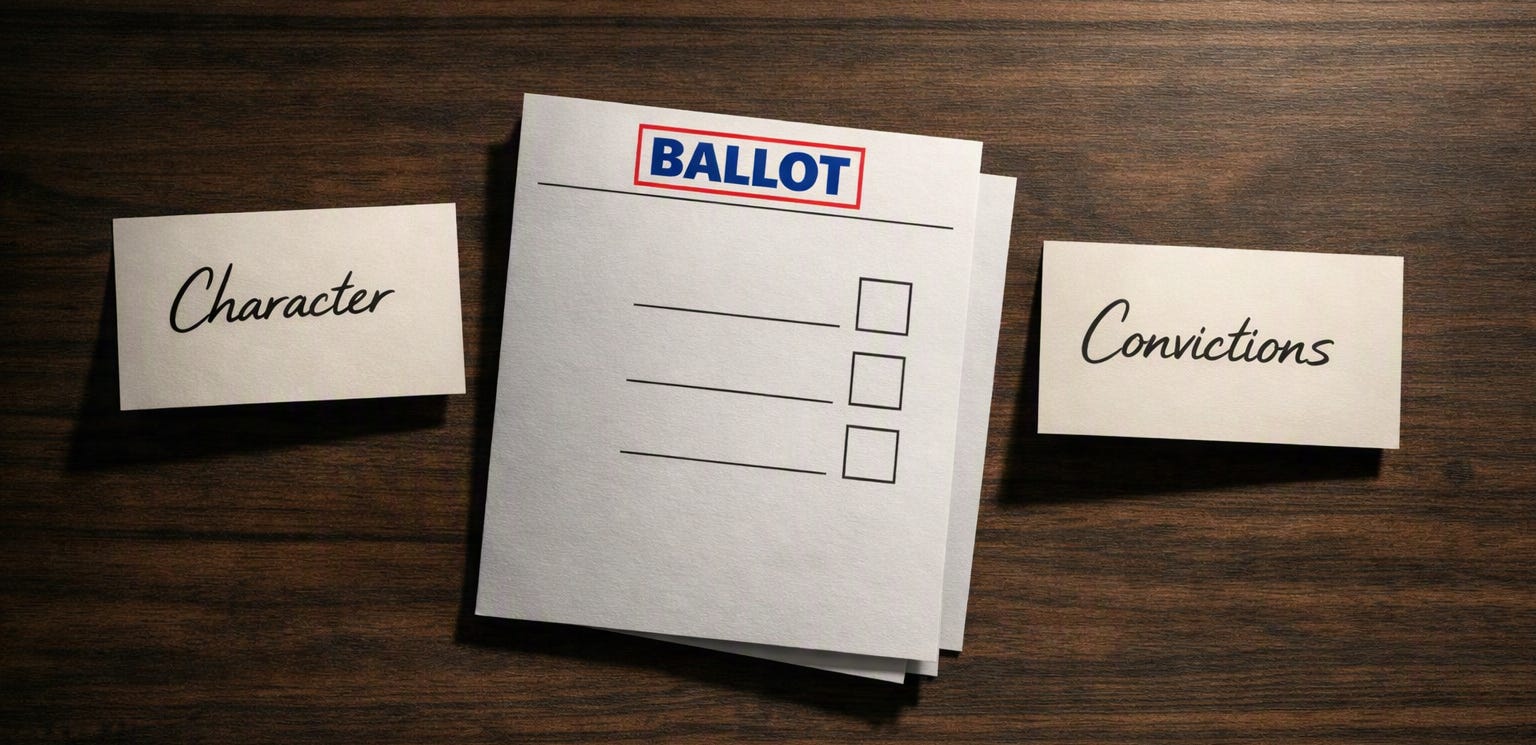
I’ve found myself asking two questions at the same time: What kind of person is this candidate? And what kind of governing choices does this candidate actually support? For me, neither question is enough by itself.
The Character Question
The first question I ask a candidate is about character. Does this person demonstrate honesty, integrity, humility, accountability and a commitment to tell the truth even when the truth is inconvenient? This matters because political leadership is an exercise of trust. A candidate’s promises tell me what they say they’ll do. Their character tells me how they’ll handle pressure, power and responsibility.
I know I can’t be certain about a candidate’s heart. Campaigns are curated, public figures are complicated, and all of us are capable of presenting a better version of ourselves than the one we see in the mirror first thing in the morning.
So, patterns of conduct also matter. A candidate can borrow the language of our faith without possessing the character that makes that language believable. Character doesn’t answer every political question, but it tells me something important about the person asking for my trust.
The Convictions Question
The second question I ask: What does this candidate actually support? Character matters, but character alone isn’t enough for me. I also need to consider whether a candidate’s positions and proposed actions align with the principles Scripture calls me to live by.
I look beyond slogans and campaign branding. What policies does the candidate support? What have they actually done when they had authority? How do they talk about people with less power? What do they seem to believe government should do, and what should it not do?
Reasonable people can disagree about policy. A Christian moral principle does not automatically produce one detailed legislative solution. But let’s not pretend policy is morally irrelevant. If politics is about how we live together, then the consequences of political choices matter to real people.
Why I Need Both
This is where my own approach has become clearer. If I choose someone based only on character, I might choose a person I believe is trustworthy but whose governing positions don’t reflect the principles my faith calls me to support.
If I choose based only on policy alignment, I might choose someone whose stated positions sound compatible with my faith while overlooking serious questions about honesty, integrity or willingness to be accountable.
Neither feels like enough.
Character tells me something about whether I can trust the person. Convictions tell me whether I can support the direction. For me, the challenge is to hold those two things together rather than allowing one to erase the other.
Don’t Confuse Christian Faith With Partisanship
This is also where I have to be especially careful with the word “Christian.” A political party can advocate for ideas that overlap with things I believe as a Christian. Another party can advocate for different ideas that also overlap with things I believe as a Christian. That doesn’t make either party the embodiment of Christianity.
My faith isn’t a party platform with a Bible verse stapled to the top.
Jesus didn’t ask me to find the political tribe that would make discipleship easiest. He asked me to follow him. That means I should be willing to recognize truth wherever I find it, challenge my own assumptions, and admit when the political tribe I might usually identify with gets something wrong.
No candidate is Jesus. No political party is the kingdom of God. That’s actually freeing. It means I don’t have to defend every statement made by the people I vote for. I can support a candidate in some areas and disagree with them in others. I can vote for someone without turning that person into a moral hero.
A Personal Application
So when I evaluate a candidate, I ask myself a few uncomfortable questions. Am I impressed by character, or merely by confidence? Am I attracted to conviction, or merely to rhetoric? Have I looked at what this person has actually done, rather than only what they promise? Am I giving my preferred candidate the benefit of the doubt while demanding impossible perfection from the other candidate?
And perhaps the most uncomfortable question: If someone I already disliked said the same thing, would I still think it was true?
That’s a good test because confirmation bias is real. Mine, at least, seems to have a graduate degree.
Christian discernment isn’t just about finding the candidate who agrees with me on the largest number of issues. It is about considering the whole picture through the moral framework I’ve chosen to follow. That means character. Convictions. Consequences. Context. And humility about what I don’t know.
The Freedom to Vote Thoughtfully
Faithful voting doesn’t require pretending there is always a perfect choice. Usually there isn’t. Sometimes the decision is between competing goods. Sometimes it is between imperfect people. Sometimes the most important question is not which candidate mirrors every conviction I hold, but which candidate’s character and governing approach I can responsibly support given the choices available.
I understand the temptation to want a cleaner answer. But maybe mature faith isn’t always about clean answers. Maybe sometimes it is about faithful discernment in messy circumstances.
I can pray. I can study. I can listen to people I disagree with. I can examine a candidate’s record. I can question my assumptions. And then I can make the best decision I can while remembering that my ultimate allegiance belongs to God, and not a politician or party platform.
My vote matters. But it isn’t my savior.
That’s a pretty important distinction.
For Further Reflection
When you decide whom to trust with public responsibility, are you paying attention both to how much the candidate’s professed beliefs align with God’s way and to the character they demonstrate when power, pressure and consequences enter the room?