



I do pro bono work at a legal aid clinic a few times a year. It’s crowded, understaffed, and the people who come through the door are usually carrying something heavy: an eviction notice, a custody dispute, a wage claim against an employer who knows they can’t afford a lawyer. They wait a long time for their turn, and when it finally comes, they have maybe twenty minutes.
I watched a woman there once, probably mid-forties, holding a folder of papers she’d clearly organized carefully, try to explain her situation to an intake worker who was already typing before she finished her second sentence. The woman slowed down, as if she thought maybe she was going too fast. She wasn’t. The worker just needed the facts that fit the form. Everything else, the part that explained why this was happening, what she’d already tried, how long she’d been living with this, was not going into any box.
At some point the woman stopped talking mid-sentence. Just stopped. She looked down at her folder, then back up, and said, ‘I just need someone to understand what’s actually going on.’
The intake worker smiled, not unkindly, and said, ‘Let’s get your information down first and go from there.’
I’ve thought about that moment more than she probably knows. Because if that’s what it feels like to go unheard by another person, to have your actual situation reduced to what fits in a form, what must it feel like to go unheard by God? The good news, and I mean this in the most literal sense, is that the Bible has a pretty clear answer. And it starts in Exodus 2.
Before the Act, the Listening
There’s a moment in Exodus 2 that’s easy to read past. The Israelites have been in bondage for generations. The text tells us they groaned. They cried out. And then, in four short verses, the camera pulls back to show us what was happening on the other side of that cry.
“God heard their groaning, and God remembered his covenant with Abraham, with Isaac, and with Jacob. God saw the Israelites and was concerned about them.” (Exodus 2:24-25)
It doesn’t say God decided to check on them. It says he heard. The cry was already in the air. And what God heard wasn’t just the pain of individuals. It was the accumulated groan of an entire people crushed under a system designed to keep them there. Hearing that, in the Bible, was never passive. It was the opening move of the most defining act of liberation in all of Scripture. Before the burning bush, before Moses, before the plagues, there was hearing. Everything else followed from that.
A God Whose Ears Are Open
This is not a one-off moment. It’s a pattern that runs from Genesis to Revelation, and once you see it, it’s hard to miss.
When Hagar, a foreign slave woman, pregnant and driven into the wilderness, collapsed near a spring, it wasn’t a priest who found her. The angel of the Lord found her and said: ‘I have heard your affliction.’ (Genesis 16:11) She responded by giving God a name no one had used before: El Roi, the God who sees. But notice what came first. He heard.
The Psalmist puts it without softening: ‘Because of the devastation of the afflicted, because of the groaning of the needy, now I will arise, says the Lord.’ (Psalm 12:5) The groaning produces movement. The cry triggers a response.
And centuries later, in the book of James, the language hasn’t cooled at all: ‘The cries of the harvesters have reached the ears of the Lord Almighty.’ (James 5:4) The full military title, Lord of Hosts, attached to the image of God leaning in to hear exploited day laborers. That’s not a small detail. That’s a portrait of a God who is constitutionally incapable of tuning it out.
What the Hearing Means
There’s a theological weight here worth naming plainly. God doesn’t hear the cries of the oppressed as background noise. He doesn’t file them as complaints to be assessed for legitimacy before deciding whether to respond. He hears them the way a parent hears a child cry out in the dark: with immediate orientation, full attention, and movement toward.
Unhearing is simply not a posture available to him. The intake worker at the legal aid clinic could close her laptop and go home. The form could be filed and the case moved along without anyone ever understanding what was actually going on. God doesn’t work that way. He doesn’t want to.
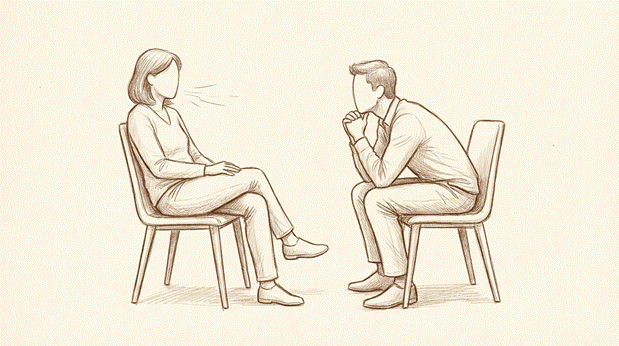
Do You Hear What God Hears?
So here’s the part that’s harder to sit with.
If this is who God is, if his defining characteristic toward the suffering and the marginalized is that he hears them, really hears them, before he does anything else, then what does that mean for those of us who claim to follow him?
Because most of us have quietly mastered the intake-window version of responding to need. We’ve figured out how to help in ways that don’t require us to actually hear anyone. And we’ve gotten very good at calling that faithfulness.
We toss a few dollars to the man sitting outside the grocery store and keep walking. Generous enough to ease the conscience, quick enough to avoid a conversation. We don’t know his name. We don’t know how long he’s been out there or what put him there. The transaction is complete. We heard enough to know he needed something. We didn’t hear him.
We drop bags of canned goods at the food pantry, which is genuinely good and genuinely needed, but we leave them at the door because actually going inside means sitting across from people and hearing things that will cost us more than soup cans. The food is real help. But it’s also insulation. It lets us care at a distance close enough to feel virtuous and far enough to stay comfortable.
Or consider the family in the congregation going through a crisis: job loss, a sick child, a marriage falling apart. We bring a meal. We send a text. We tell them we’re praying. All of it is kind. None of it requires us to sit with them in the hard part long enough to actually understand what they’re carrying. Hearing that would change us, and changing is inconvenient.
This is not a condemnation. It’s a description, and I include myself in it without hesitation. We are all, to some degree, walking around with our own intake forms: the version of someone else’s need that we’re willing to process, and the line beyond which we’d rather not go.
But the God of Scripture doesn’t carry an intake form. He hears the whole thing. The backstory. The part the woman in that clinic folder had organized carefully and nobody asked about. The groan underneath the groan. And his hearing always has a next move.
The question isn’t whether we can match that perfectly. We can’t. The question is whether we’re willing to put down the form long enough to actually hear someone and let what we hear do something to us.
Hearing is where it starts. But as we’ll see, it is never where God stops.
We’ve figured out how to help in ways that don’t require us to hear anyone. And we’ve gotten very good at calling that faithfulness.
For Further Reflection Think about the last time you helped someone at a safe distance: a donation dropped off, a check written, a text sent. You called it enough. What would it have looked like to actually hear them instead? And what were you protecting yourself from by not?
Next is Part 2, “Invisible. Except to God.”
Harvey, God has used you as a conduit for his words, his message, his ideas. I am very grateful to have read this.