


Imagine taking a pair of scissors to the Bible and cutting out 90% of the Old Testament and about 50% of the New Testament in order to remove the parts that could inspire enslaved people with hope for liberation, while emphasizing the parts that justified and fortified a system that oppressed, dehumanized and brutalized them. Leaving you with a “holy book” that includes the Ten Commandments but skips the entire Exodus story (that could inspire hope for liberation), all of the Psalms (hope for God’s deliverance from oppression), and the entire Book of Revelation (most associated with divine justice and the overthrow of oppressive powers). Ridiculous, right? But it actually happened.
In 1807, a printer in London bound a book that looked exactly like a Bible. It had a leather cover, gilt lettering, and even a ribbon marker tucked in the spine, but the page numbers started skipping where whole sections were removed—the entire story of Israel walking out of slavery and the hopeful messages of liberation in the Psalms and Revelation simply gone. It is real and is commonly referred to as the “Slave Bible.”
An Anglican missionary society produced the Slave Bible for the sugar colonies of the Caribbean. The verses telling servants to obey their masters were left in, but the verses that might have told an enslaved person that God takes sides against the one holding the whip did not.
And that’s really part of a pattern that keeps showing up at least three distinct ways, each serving double duty as a warning to us.
The crudest version is the simplest to name: you just cut out uncomfortable parts. The Slave Bible is the bluntest example of the “cut it” strategy, but it wasn’t the only time someone took actual scissors to the text. In 1939, eleven German Protestant regional churches founded something called the Institute for the Study and Eradication of Jewish Influence on German Church Life with the stated purpose to “dejudaize” German Christianity. It produced a New Testament that removed Jesus’s genealogies that trace his Jewish/Davidic ancestry, stripped out Old Testament quotations, and recast Jesus into an Aryan figure at war with Judaism. Eighty years later in 2019, eight of those same regional Protestant churches (note that’s only eight of the original eleven churches) erected a public memorial of confession in Eisenach confessing their own guilt out loud.
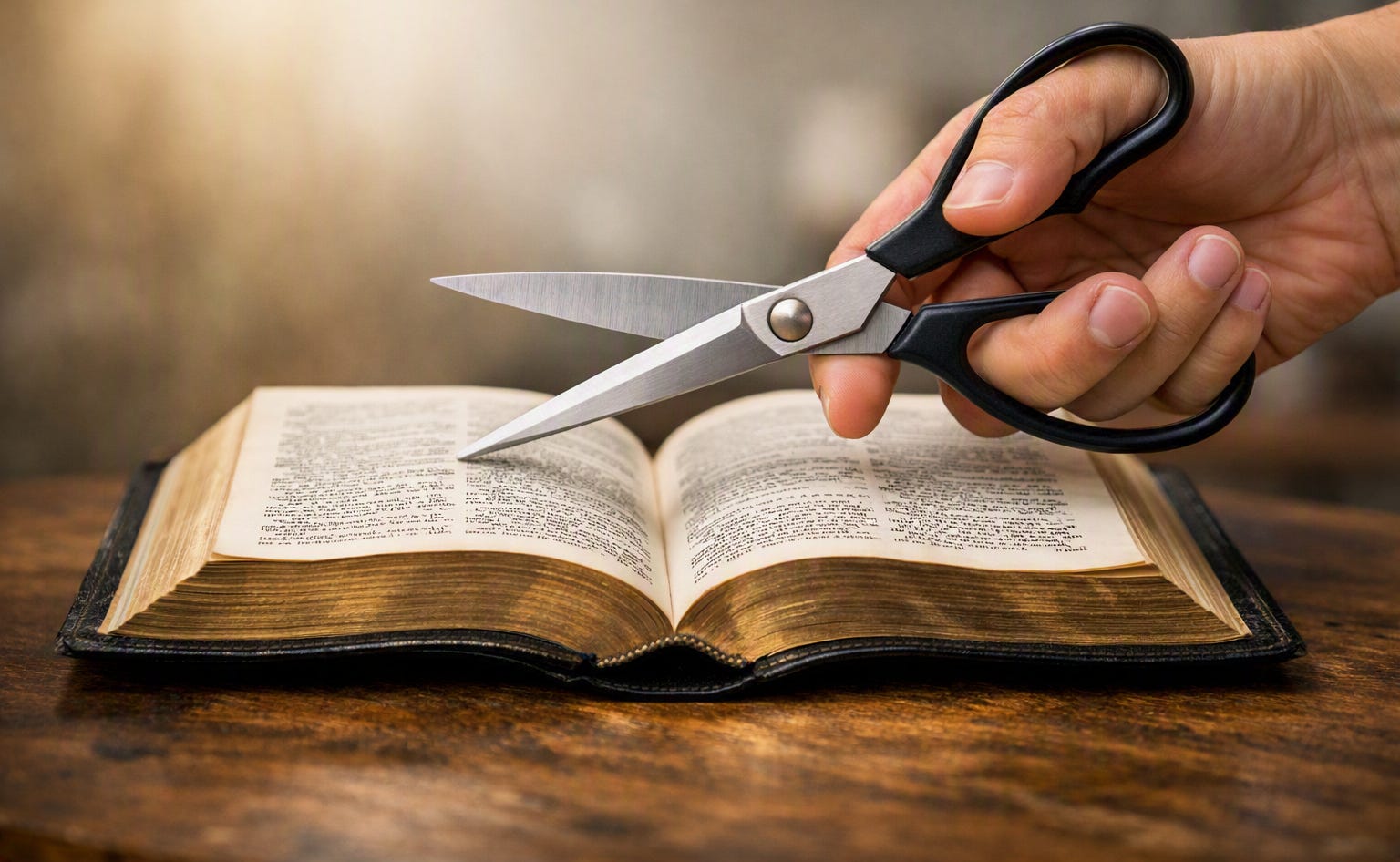
Neither of those events is subtle because both required someone to physically decide which pages stayed and which ones would be cut. Very few of us will ever sit on a committee that literally cuts scripture, but how about when someone decides that a topic is off limits for a sermon, a Bible study, or a Thanksgiving table conversation because it’s “too political,” or “too controversial.” They may not be tearing the page out of the Books of Amos, Micah or Isaiah, but tacitly deciding not to accept or discuss accomplishes the same result.
The second version doesn’t need scissors at all if you just keep preaching the same fraction of the book, until the rest goes quiet from disuse. Rev. Charles Colcock Jones, a Presbyterian minister and plantation owner in Georgia, wrote a catechism (think of it as a doctrinal FAQ) used widely across the antebellum South to instruct enslaved people in the faith. In it he addressed how a newly religious enslaved person ought to behave toward their master: be honest, diligent, and faithful, and even when whipped for doing well, take it patiently and look to God for reward. Rev. Jones cited Ephesians 6 and Titus 2, “slaves, obey your masters,” and simply never got around to Exodus, or the prophets’ repeated indictments of landowners who took advantage of the poor. The scissors were replaced with merely narrowing the text down to the parts convenient for the person doing the teaching.
The same move shows up whenever “submit to governing authorities” from Romans 13 gets preached as a stand-alone command, unaccompanied by the repeated examples of prophets confronting kings to their faces, or by Peter telling the religious authorities in Acts 5 that he must obey God rather than men. Instead of getting cut out from the Bible, it just gets read in isolation from the parts of the same Bible that complicate it.
And consider how some Christian nationalist arguments cite 2 Chronicles 7:14, God’s promise to Solomon that if his people humble themselves, God will heal their land. One theologian called it “the John 3:16 of American civil religion.” Critics point out that the verse was spoken to Israel about Israel’s temple, and that lifting it into a promise about America requires quietly setting aside the fact that the passage never mentions America at all. Notice how that argument uses one convenient verse, repeated often, to stand in for a book that has a great deal more to say.
The third version doesn’t either remove anything or play favorites among verses. Instead, it takes an intact passage and reads it to mean something pretty close to its opposite. I call that interpretive contortionism.
The Dutch Reformed Church (DRC) in apartheid-era South Africa built an entire official theology on the Tower of Babel in Genesis 11. Those DRC theologians argued that God scattering the nations and confusing their languages proved that God intended permanent racial separation as a matter of divine design, and codified that interpretation in church policy in 1974. But if you actually read Genesis 11, the scattering looks like judgment on human pride and not a blueprint for keeping people apart by skin color, race or ethnicity.
We can do a smaller version of all three without noticing when we focus on personal piety, purity, devotion, and tithing, but ignore or minimize the parts on mercy and justice. Not because we cut Micah 6:8 out of our Bibles, but because we’ve quietly decided that justice is someone else’s assignment, contrary to what the Bible as a whole actually says. Or maybe we take entire categories like poverty, immigration, or the treatment of the imprisoned, and set them in a box marked “political” or “worldly” as though a subject the prophets addressed by name for eight straight centuries somehow stopped being God’s business the moment it showed up on a ballot.
We’ve slyly replaced the scissors with one of those same three habits the historical examples demonstrated: cut what’s inconvenient, keep circling the verses that already agree with you, and if a passage still won’t cooperate, reconsider its meaning until it does.

We don’t need an institute or a printing press to get a smaller Bible than the one we own. Just enough Sundays where the convenient parts get read out loud and the costly parts don’t.
For Further Reflection
Think of the last time you heard a fellow believer read a passage differently than you do. Did you ask what they saw there, or did you just decide they’d gotten it wrong? And is there a topic you’ve quietly filed under “political” or “worldly” or “extreme” that the prophets would have filed under “obedience”?
Harvey the line about replacing scissors with habit got me. A Bible can stay physically whole and still get smaller when the same safe verses are the only ones read out loud. I see that most when Romans 13 is quoted by itself, with no room for the prophets confronting kings or Acts 5. That selective reading can train people to confuse peace with silence. It makes me want to ask, not just what a passage says, but what nearby passages we keep leaving out.
It makes me angry that purported Christians would willfully use the bible as a weapon to advance their own agendas.
And since I have my own agendas, I need to take a good hard look at the parts of the bible that I neglect (intentionally or unintentionally) as I form my own belief system based on the bible. My only hope is for Holy Spirit guidance 🙏🏼