



Every institution I have ever worked in or around has a version of the same meeting. Something has gone wrong. The people in the room know it. And then, one careful statement at a time, a consensus forms around not quite saying so. Concerns are noted. Complexity is acknowledged. The importance of not getting ahead of the facts is invoked. Someone mentions that there are perspectives on all sides that deserve to be heard.
By the end of the meeting, nothing has been named and nothing has been decided, and the people most affected by what went wrong are still waiting.
I have sat in those meetings as a lawyer, as a volunteer, as a congregant. And I’ve noticed something consistent across all of them: the people doing the careful not-saying always frame it as responsibility. As wisdom. As the mature, measured response to a complicated situation.
The people on the receiving end of it experience something else entirely. They experience abandonment.
This week I want to run a thought experiment, a “what-if” scenario. What if God operated the same way?
A Thought Experiment with Real Stakes
Imagine, for a moment, that in Exodus God had adopted a posture of careful neutrality. That he had decided the Israelites’ situation in Egypt was complex, with legitimate concerns on multiple sides. That he had chosen not to get involved in what was, after all, a political situation. That naming oppressors and confronting systems was not his place. That his role was spiritual, not social.
Israel stays in Egypt (Exodus). For another generation, and another. The groaning continues. The cry goes up. And nothing comes back down.
Hagar (Genesis 16) collapses at the spring and no one finds her. Naboth (1 Kings 21) is murdered and the king keeps the vineyard. The wages are stolen and the workers (James 5:1-6) have nowhere to turn. The widow (Luke 18:1-8) comes to the unjust judge again and again and is turned away, and there is no parable about a God who hears—because this God does not hear, or if he hears, decides it is not his place to act.
The hungry stay hungry. The stranger stays unwelcome. The prisoner stays forgotten. And the religious assemblies continue, carefully, without disruption.
That is not a description of the God of Scripture. But it is, if we are honest, a description of something. And the resemblance to certain institutional postures we have all witnessed is not coincidental.
The Radical Nature of What We Actually Have
This what-if experiment isn’t frivolous. It’s designed to force a recognition we are in danger of losing: how radical God’s actual responsiveness to injustice really is.
We’ve spent four articles tracing a God who hears the groan underneath the groan, who sees the people the world has rendered invisible, who names exploitation by its exact price point, and who moves—in his own mysterious timing, but without exception—from attentiveness into action. That is not the portrait of a God who is neutral on suffering. That is the portrait of a God for whom the cry of the oppressed is among the most urgent things in the universe.
The contrast with contemporary Christian quietism on racial, social, and economic injustice is stark. When the church issues careful non-statements, when leaders avoid naming what is plainly visible, when congregations treat justice as political controversy rather than theological imperative, they are modeling something. But it is not the God of Scripture. It is the God of the what-if experiment. And the Bible does not recognize that posture as faithfulness.
The Silence Is Not Hypothetical
Here is where the thought experiment stops being a thought experiment.
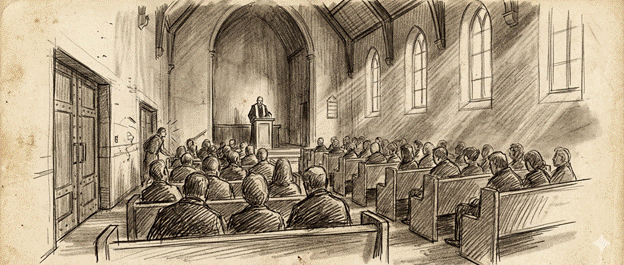
For millions of people alive right now, the silence this article imagines is not hypothetical. It is their lived experience of the church.
They have cried out—about racial violence, about wage theft, about the treatment of immigrants, about housing, about the criminal justice system—and the response from many quarters of Christianity has been the studied silence of an institution trying not to offend anyone with power, or those who insist on maintaining congregational comfort and order and not become partisan or political.
They have watched churches fill on Sunday mornings and empty out on the question of justice. They have watched religious leaders parse and equivocate while the people Amos described (Amos 2:6)—those sold for a pair of sandals, those whose wages cry out to heaven—wait for someone to stand in the gap.
And many of them have concluded, not unreasonably, that the God those churches represent is the silent one. The neutral one. The one who hears the groaning and decides it is not his place to get involved.
The silent church is a theological crisis. Not primarily for the people who have left. For the church that drove them out with its silence.
What Kind of God Are You Representing?
This is where the what-if experiment becomes personal. Because institutions are made of people. And the studied silence of any church, denomination, or religious body is not an abstraction. It is the accumulated weight of individual decisions made by individual people—including people like us—to say nothing or do nothing, but call it wisdom.
Every time someone in a congregation decides that a sermon on justice would be ‘too political,’ the silent God gets a little more real to the people outside those walls. Every time a church board tables a discussion about racial equity because ‘this isn’t the right moment,’ the waiting gets longer for the people Amos described. Every time a person of faith shares a carefully worded social media post that acknowledges complexity without naming the injustice, the what-if experiment inches closer to actual policy.
I am not exempting myself from this. I have been in those meetings. I have chosen the careful word when a clearer one was available. I have framed my inaction as prudence and my silence as respect for different perspectives. I know what it feels like from the inside, and I know how reasonable it seems at the time.
Sometimes the silence is dressed in more sophisticated clothing. We tell ourselves we can’t respond to every injustice, so we have to choose our battles—which is true, and also sometimes a way of never choosing any. We invoke Jesus’s words that ‘the poor you will always have with you’ as if he were counseling resignation, when the full passage he was quoting from Deuteronomy was a command to open our hands precisely because the need would always be there. We have, as a church, become quite skilled at using Scripture to make peace with the very things Scripture was written to disturb.
But the God this series has been tracing doesn’t reason that way. He hears and moves. He sees and names. He is not careful in the way institutions are careful. He is not neutral in the way leaders who fear controversy are neutral. He is constitutionally, irreversibly, thoroughly on the side of the person crying out.
The question for those of us who carry his name is not whether we agree with that description of God. Most of us do, at least in the abstract. The question is whether the God we represent in our actual decisions—in our silences, our meetings, our carefully worded non-statements—is the same one.
What kind of God are you or your church representing? Not in your theology. In your choices.
The answer to that question sets up everything we’ll look at in the final two articles — what it means to bear his image, and the standard he holds those who know him to.
The silent church is a theological crisis. Not primarily for the people who have left. For the church that drove them out with its silence.
For Further Reflection Think about a moment when you framed your silence or inaction as wisdom, balance, or respect for complexity. Who benefited from that framing? Who was still waiting when the meeting ended? And what would it have looked like to represent the God of Exodus instead of the God of the what-if experiment?
Nect is Part 6, “A Compass Doesn’t Care How Long You’ve Been Standing Still.”
"to say nothing or do nothing, but call it wisdom." Excellent post. I will re-post. I chose not to be silent. I don't always get it right, and there is risk involved, but the Holy Spirit is compelling me to speak.
Powerful!!!!
🙏🏾🙏🏾🙏🏾🙏🏾🙏🏾
What kind of God are you or your church representing? Not in your theology. In your choices.
"We have, as a church, become quite skilled at using Scripture to make peace with the very things Scripture was written to disturb....
The silent church is a theological crisis. Not primarily for the people who have left. For the church that drove them out with its silence....
What Kind of God Are You Representing?"