



Love Has a Range
God’s list of people to love starts at home and moves outward. Then it circles back to the hardest one of all.
Nobody has ever been kicked off a church committee for being too loving.
Think about that. We argue about almost everything else. Worship styles, women in the pulpit, what the Bible says about money, whether the coffee in the fellowship hall counts as a sacrament (it doesn’t, though some of us treat it that way).
But love gets a pass. First Corinthians 13 gets read at weddings where half the guests couldn’t find Corinthians without the table of contents. “Love your neighbor” shows up on yard signs on both sides of the street, sometimes on the same block, sometimes aimed at each other.
Love is the a virtue everyone claims. After all, it should come naturally. John says it plainly: “God is love” (1 John 4:8). If we’re made in his image, shouldn’t love be our native language? And, “We love because he first loved us” (1 John 4:19).
Deuteronomy 10 shows how this works in two verses. In verse 18, God “loves the foreigner residing among you, giving them food and clothing.” In verse 19, the command follows: “And you are to love those who are foreigners.”
God loves someone first. Then he invites us to join him.
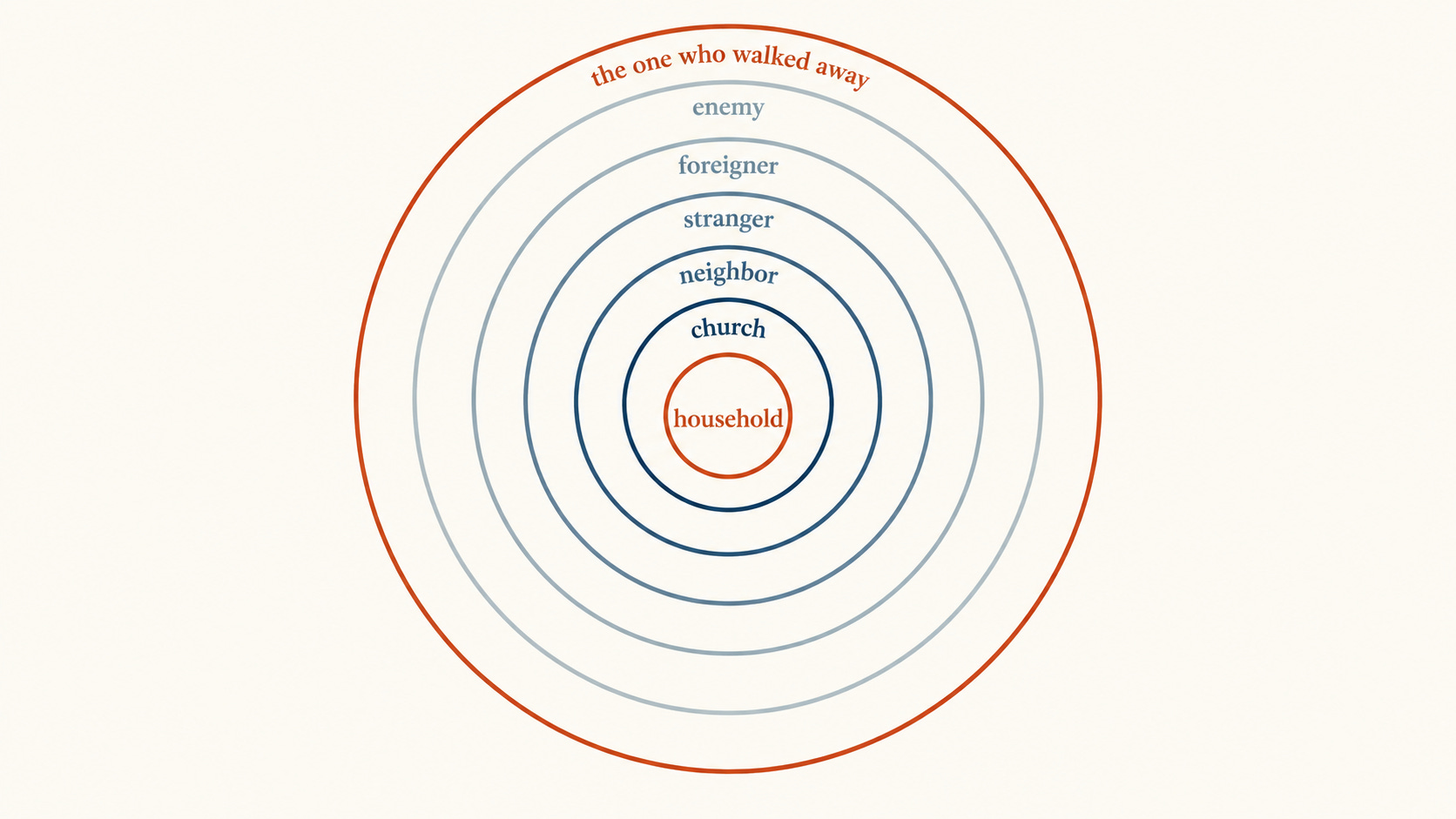
Scripture names seven kinds of people God tells us to love. As you read, keep an honest tally of how many you’d check off without hesitating. That is, the ones you actually do regularly, in concrete ways, integrated into your routine and habit.
They start close to home. Pay attention to where they end.
Seven People, Moving Outward
Your own household
Paul tells husbands to “love your wives, just as Christ loved the church and gave himself up for her” (Ephesians 5:25). Titus 2:4 tells older women to teach younger women to love their husbands and children.
Obvious, right? These are the people you chose and the people you made.
But look closer. In a Roman household the husband held nearly all the legal power, and he’s exactly who Paul aims the command at. In Colossians 3:19 Paul adds “do not be harsh with them,” which suggests somebody needed to hear it. I know I love my family, but when I’m short, on edge, or moody, is that really reflecting love? And when they point out my moodiness or have a different idea on an issue, is “patience, kindess, etc.” my first instinct?
Titus says love for your own family has to be taught, suggesting that doing just that as a matter of routine and habit may not be as easy as we think.
One another
Jesus gave this command at the Last Supper: “As I have loved you, so you must love one another. By this everyone will know that you are my disciples” (John 13:34-35). Same pews, same potlucks, same Lord. Should be easy.
Then John raises the stakes: “Whoever claims to love God yet hates a brother or sister is a liar” (1 John 4:20). He doesn’t just say they’re confused. He calls that person a liar.
Jesus made love for each other the public ID card of his followers. Spend thirty minutes at a church business meeting, an extended fellowship time, or one-on-one coffee with another member. What criticisms are leveled at other church members, what personal agendas are pursued over other agendas, or what gossipy comments are made about others? Or notice whether those welcome at or actually attending those meetings must fit a certain demographic or ethnic profile. If so, maybe that love for another is more conditional than you think
Your neighbor
Leviticus 19:18 gives us the most quoted command in the Bible: “Love your neighbor as yourself.” Jesus calls it the second greatest commandment. Almost nobody disagrees with it.
Here’s the thing about neighbors, though. Most of ours look a lot like us. Same zip code, similar income, same church or same lack of one, often the same politics. We picked the neighborhood, so in a sense we picked the neighbors. Loving them can come uncomfortably close to loving ourselves at a different address.
That’s why the lawyer in Luke 10 asks, “And who is my neighbor?” It’s a question about where the obligation stops. In other words, “who do I have your permission not to love, Jesus?”
Jesus answers with a story whose hero is a Samaritan: a man of the wrong religion and the wrong ethnicity, from a region the audience had been raised to despise. Then Jesus flips the question. He doesn’t ask who qualifies as your neighbor. He asks who acted like one. In Luke 10, the lawyer can’t even bring himself to say “the Samaritan.” He says “the one who had mercy on him.”
Jesus never drew the line he was asked for. He erased it. That’s the standard for loving your neighbor the Jesus way.
The stranger
“Do not forget to show hospitality to strangers, for by so doing some people have shown hospitality to angels without knowing it” (Hebrews 13:2).
The Greek word behind “hospitality” is philoxenia. Literally, love of strangers. Its opposite is a word you already know: xenophobia, fear of strangers.
Scripture gave us a word for loving the unknown person at the door (philoxenia). Our culture today has gotten a lot more fluent in the other one (xenophobia).
This is usually where the tally starts to slip. The stranger may just be the first person on this list who costs some comfort. “I don’t know them.” “They don’t look friendly.” “What if they’re dangerous?” “Aren’t there agencies available to help them?”
Many reasons to keep our distance, but that’s exactly why we need Christian love to do it. Nobody said it would always be easy or comfortable.
The foreigner
“The foreigner residing among you must be treated as your native-born. Love them as yourself, for you were foreigners in Egypt” (Leviticus 19:34).
Same phrase as the neighbor command, sixteen verses later. That’s on purpose.
The stranger passes through. The foreigner stays. They move in down the street, enroll their kids at your school, and speak a language you don’t. The stranger costs you an afternoon. The foreigner costs you a change in who you mean when you say “us.”
“But they’re different.” “I can’t understand their accent.” “I don’t understand their customs.” “They have a different religion.” “They look dangerous.”
Many reasons to dismiss the call to love the foreigner. None of them good ones.
This is also the command we’re most tempted to turn into a policy argument, because arguing about policy lets us skip the part where we love an actual person. Scripture doesn’t leave us that exit. God says he loves the foreigner himself. It’s hard to claim to be on his side while standing against the people he loves.
Your enemy
“Love your enemies, do good to those who hate you, bless those who curse you, pray for those who mistreat you” (Luke 6:27-28). Jesus gives the reason a few verses later: God “is kind to the ungrateful and wicked” (Luke 6:35). Every one of us has benefited from that.
Too often we’ve quietly downgraded “enemy” to mean the coworker who hits reply-all or the uncle who forwards the memes. Those people are fairly easy to love, which lets us feel obedient.
But Jesus meant people who curse you and mean you harm. That list is shorter, and a lot harder to pray for by name. I have someone in my life who is currently cursing at me and wishing me harm through unsolicited texts, fabricated stories, and angry missives. Honestly, I am having a hard time feeling love for that person or even seeing myself ever again feeling love for that person.
Loving the enemy is hard, very hard.
But it’s the command, and something I must work hard to do myself.
The one who walked away
If you’ve been tracking the pattern, you’re probably expecting the last entry to be the farthest person yet, the one hardest to love. It isn’t.
In Hosea 3:1, God tells the prophet: “Go, show your love to your wife again, though she is loved by another man and is an adulteress. Love her as the Lord loves the Israelites, though they turn to other gods.”
The list ends with a marriage. Right where it began.
The hardest person on the list isn’t a foreigner or an enemy. It’s someone who used to be at the center of your life and chose to leave. Maybe a spouse, a sibling, a friend, a grown child.
Your enemy never promised you anything. This person did. And God says go back, because that’s what he has done with us over and over. Hosea’s marriage is God’s own story with his people, acted out in one house.
Perhaps someone already came to mind for you. Be honest.
Grading on the Easy Half
In 2017, psychologists Ben Tappin and Ryan McKay asked 270 people to rate themselves and the average person on 30 traits. Nearly everyone inflated their own moral qualities, and the moral inflation was bigger than for any other kind of trait they measured.
On trustworthiness, people gave themselves an average of 6.1 and gave everyone else 4.3. The researchers called this perceived moral superiority “a uniquely strong and prevalent form of positive illusion.” Translation: we are all the least judgmental person we know.
So check your tally. If the first half of the list above felt easy (household, church family, neighbor) and the second half didn’t (stranger, foreigner, enemy, loved one who rejected you), that’s the illusion at work.
We grade our love on the entries we’re good at and quietly skip the rest. And if the research is right, even the entries you checked off might deserve a second look.
Jesus saw this coming. “If you love those who love you, what reward will you get? Are not even the tax collectors doing that?” (Matthew 5:46). Loving people who love you back is the floor, and Jesus keeps pointing at the ceiling.
Paul prays that the Thessalonians’ love would grow “for each other and for everyone else” (1 Thessalonians 3:12). Everyone else. He prayed that for the church. Because the church needed it.
Love that only flows toward people like you isn’t grace. It’s gravity.
Love takes effort, and Scripture never pretends otherwise. Colossians 3:14 tells us to “put on love,” the way you put on clothes: on purpose, every morning, whether or not your tired or feel like it.
First Peter 1:22 says to love one another “deeply,” using a Greek word tied to stretching and straining. And the simplest clue is that God had to command love at all.
I’ll be honest about my own tally. I did fine through the neighbor, as long as I got to pick which neighbor. I also did okay with some strangers (selectively). After that it fell apart fast, which is a little awkward for a guy who writes a Substack about justice. I don’t go out of my way to love the foreigner as much as I have opportunity to, and my love for the enemy who is cursing me or the family member who has hurt me is a challenge. I need this reminder of who God calls, even commands, me to love.
So find the ring where your love stops, and put an actual name there, a specific person with a face. If it’s number seven, that may be the hardest name you write down. It may also be the one that looks most like God’s story with you.
The effort doesn’t have to be dramatic. Say their name out loud in a prayer, or multiple prayers repeatedly if needed. Send one text or card. Buy one lunch. Have the conversation you’ve been dodging for too long.
The circle ends where it started. So does the work.
For Further Reflection
The easy half of the list shows who we love. The hard half shows whether we’ve understood God at all. Find the ring where your love stops, and decide on one small step toward the person standing there.
This is challenging to say the least! But true. And yes, that very last one - not an enemy, but members (plural) of my former family (long story there) - *that's* the very hardest of all. I never even considered that before, but it's true. And yes, I can name names. Remembering each one of their names is easy, because they are (were) family. But loving them, now, ...well, I'll let you know when I've completed that. And thus completed the circle.
I'll try not to make you wait too long - or rather, make God wait too long. Obviously I'll need prayer and lots of it. I guess we all do.
Not easy reading, but right. Thank you.
Love is the measuring stick! Thanks for such a thoughtful article!