


Where is God when the world is falling apart?
It’s the oldest question in the book , literally. Job asked it. The psalmists asked it. Jeremiah asked it from inside the ruins of Jerusalem. And if you’re paying attention to your own life, or to the news, or to a community suffering around you, chances are you’ve asked it too. Maybe more urgently in this moment than in a long time.
Most of us don’t ask it out loud. We manage it. We scroll past the thing that breaks our heart, or we pray a prayer that feels like it bounces off the ceiling, or we go quiet in a way that looks like peace but is actually something closer to resignation. And underneath all of it is the question we’re not quite asking: is anyone up there paying attention?
The Israelites knew that feeling across four hundred years of slavery in Egypt. Where, exactly, was the great and mighty God of Abraham in those four centuries of brick-making and brutality?
The prophet Jeremiah knew it, writing his laments from the ruins of Jerusalem.
The early disciples knew it on the night Jesus was arrested, scattering in every direction. And then they knew it again, with terrifying finality, on the day they watched him die.
End of story. Obviously.
Except that it wasn’t. And that’s not just a punchline about Easter Sunday. It’s something more specific and more useful, something embedded in one of the oldest confessions in the Christian tradition. But we’ll get to that. First, three things worth understanding about what divine silence actually is, and isn’t.

Silence Is Not the Same as Absence
When the Israelites finally left Egypt after four centuries of bondage, they did not enter a comfortable journey. They entered a wilderness. And God led them through it not with advance explanations but with a pillar of cloud by day and a pillar of fire by night. Visible, present, immediate. They were not abandoned. They were being led somewhere, but to them it looked like nowhere. And no explanation.
Much later, the prophet Elijah collapsed in the desert after his greatest victory and begged God to let him die. God’s response was not a sermon or a strategy session. An angel appeared with bread and water. “Get up and eat,” the angel said, “for the journey is too much for you.” (1 Kings 19:7) Not an explanation. A meal. God showed up in the most ordinary, human, quietly attentive way imaginable, and met Elijah exactly where he was. And still no explanation.
Psalm 22, the psalm Jesus would quote from the cross, opens with one of the most anguished cries in all of Scripture: “My God, my God, why have you forsaken me? Why are you so far from saving me?” (Psalm 22:1) That is not a polite prayer. It is a person in genuine anguish, crying out into what feels like an empty sky. And yet the same psalm lands, two dozen verses later, here: “For he has not despised or scorned the suffering of the afflicted one; he has not hidden his face from him but has listened to his cry for help.” (Psalm 22:24) The feeling of abandonment was real. But the abandonment itself was not.
Silence, in the biblical imagination, is not absence. God is not always loud. God does not always show up the way we’d prefer, on the schedule we’d prefer, with the explanation we feel we’re owed. But God does not leave.
Silence is not the same as absence. God is not always loud. But God does not leave.
Absence Is Not the Same as Inactivity
The book of Esther is one of the strangest books in the Bible for a very specific reason: God is never mentioned. Not once. No prayer, no miracle, no divine voice. And yet the entire story turns on a sequence of events so improbably timed that the rabbis concluded one thing. God’s fingerprints are all over the story. His name is simply nowhere in it.
Joseph’s story in Genesis makes the same argument across a longer arc. Sold into slavery by his own brothers, falsely accused, imprisoned for years, forgotten. If Joseph prayed during those years, we don’t see the prayers answered in any visible or felt way. No miracle arrives. The silence stretches. And then, when the story finally bends, Joseph’s own theological summary is quietly stunning: “You intended to harm me, but God intended it for good.” (Genesis 50:20) Looking backward, he could see the thread running through what had felt, in each moment, like chaos and catastrophe. God’s activity had been invisible. But God had not been absent.
The same pattern runs through the divided kingdom (1 Kings 12), through the Babylonian exile (2 Kings 25; Lamentations 1–5), through every season when Israel found itself scattered, diminished, or defeated. The prophets kept insisting, into what must have seemed like obvious evidence to the contrary, that God had not stopped working. That the worst moments in the nation’s story were not proof of divine abandonment but of divine patience, and often of divine discipline that was itself a form of faithfulness.
Here is what I keep taking from all of this: invisible does not mean inactive. The seasons that feel most abandoned are not, historically, the seasons where God has stopped working. Sometimes, uncomfortably, they are the seasons where God is working most deeply. Most patiently. Most invisibly. And most often, if we’re honest, that work is being done in us rather than for us. It is in the seasons when we cannot rely on our own performance, our own comfort, our own sense that things are going well, that we are most likely to learn what actual reliance on God looks like. The dark times have a way of producing what the good times never quite manage.

Lament Is Not the Same as Abandonment
The Psalms contain 42 lament psalms. More than any other type. The most repeated genre in Israel’s prayer book is not praise or thanksgiving. It is honest, anguished, sometimes furious complaint directed straight at God. Lament, it turns out, is what honest faith does in the dark. And the biblical tradition doesn’t flinch from that. These prayers were not edited out of Scripture. They were preserved, canonized, and handed to every generation as the legitimate language of faith in hard times.
The lament in Psalm 88 ends without resolution. No turn toward hope. No “but I will trust.” The final line is actually: “darkness is my closest friend.” And someone decided that prayer belonged in Scripture. Which means the tradition is telling us something important: this is what honest faith can sound like, and it is not a failure or evidence of God having abandoned.
Job spends thirty-seven chapters arguing with God, accusing God, demanding an answer from God. When God finally speaks, the rebuke is not for Job. It is for Job’s friends, who had been defending God with tidy theological explanations. “You have not spoken the truth about me,” God tells them, “as my servant Job has.” (Job 42:7) The man who yelled at God was vindicated. The men who had managed their theology politely were not.
Lament is not the sound of faith breaking. It is often the sound of faith insisting. It says: I still believe you’re there. I am not walking away. I am bringing this to you precisely because I believe the relationship can hold the weight of my honesty. That is not abandonment. That is intimacy. And it is, perhaps, exactly what Jesus had in mind when he said: “Come to me, all you who are weary and burdened, and I will give you rest.” (Matthew 11:28) The invitation was never to tidy yourself up first. It was to come as you are, darkness and all.
Lament is not the sound of faith breaking. It is often the sound of faith insisting.
The Day It Was Obviously Over
Which brings us to the one moment in history that puts all three of these claims to their ultimate test.
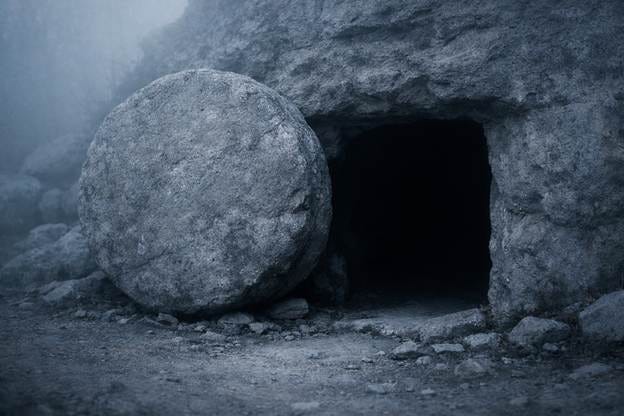
The disciples scattered when Jesus was arrested. That much is clear from all four Gospels. The movement they had given up everything to join was over. Then came the trial, the verdict, the cross. And then the burial. Stone rolled into place. Guards posted. End of story.
Holy Saturday—the day between the cross and the resurrection—is the day no one preaches on. Good Friday is dramatic. Easter Sunday is triumphant. But Saturday is just… nothing. The disciples sat in grief and confusion, certain the story was finished, trying to figure out what to do with the ruins of everything they’d believed.
There is an ancient clause tucked into the Apostles’ Creed that most of us rush past without thinking about it: “He descended into hell”—or in some translations, “He descended to the dead.” Jason Porterfield, in his book Fight Like Jesus, draws on this line to make a point worth sitting with. Holy Saturday, he argues, was not simply a pause between the tragedy and the triumph. Even in death, even in the place that seemed most completely beyond God’s reach, Jesus was not idle.
Think about what that means. The stone was in place. The guards were posted. And according to one of Christianity’s oldest confessions, Jesus was still at work—present even there, extending the same mission into the one place that seemed most completely beyond its reach. The tomb wasn’t the end of the story. It was the furthest point of it.
That is either the most audacious claim in all of theology, or it is the key that unlocks everything else. If God was actively at work on the day the story was most obviously over, then the pattern holds in every direction. Four hundred years of Egyptian slavery. The divided kingdom. The exile. The arrest. The burial. Every moment that looked, from the inside, like God had finally given up.
None of those moments were the end of the story. They were the part of the story that hadn’t turned yet.
I don’t know what your Saturday looks like. Maybe it’s a diagnosis that arrived without warning. Maybe it’s a marriage coming apart at the seams. Maybe it’s watching your community targeted, your neighbors treated as less than human, the vulnerable stripped of protections they were promised—and wondering how a just God could be silent through any of it. These are not small questions. They are not faithless ones. They are the sound of people who still believe enough to be furious.
Here is what the whole sweep of Scripture keeps insisting, from Egypt to Esther to Easter: the silence is not the verdict. The invisible is not the inactive. The ache you feel when you call out and hear nothing back is not evidence that no one is listening. It may simply mean you are in the part of the story that hasn’t turned yet. That you just don’t see what God is doing.
And the dark seasons, as uncomfortable as it is to say this, are often the ones that do the deepest work. Not the work we asked for. The work that teaches us to stop relying on our own performance and start actually relying on God. That distinction matters more than most of us want to admit.
Keep showing up. Keep being honest. Keep lamenting, if that’s where you are. The door you’re knocking on is the right one, even when it seems to stay shut.
Saturday might indeed be a very long day, but it is not the last word.
For Further Reflection
Which feels most true to you right now: that God is absent, that God is inactive, or that your honest anguish means something has gone wrong with your faith? What would it mean to take one of the biblical examples in this article seriously—not as a theological argument, but as a word for your actual situation today?
WOW! What a wonderful and insightful Bible devotional/ commentary. I believe that God is always at work, even when I can't see what He's doing. He has proven His faithfulness to me again and again. I am encouraged by this lesson to continue to show up, to continue to knock, and to continue to express myself in the most authentic fashion. The quote, "I believe the relationship can hold the weight of my honesty" resonates with me. This perspective carries over into my other relationships as well. The relationship with my wife. The relationships with my daughters. The relationship with my mother. The relationships with my friends. It's important for me to be authentic and honest and to trust that all of these relationships can hold that weight.
Thank you, Harvey. Inspiring.