


This is Part 3 of 3 in a series about who God notices. Start with Part 1 here, and go to Part 2 here.
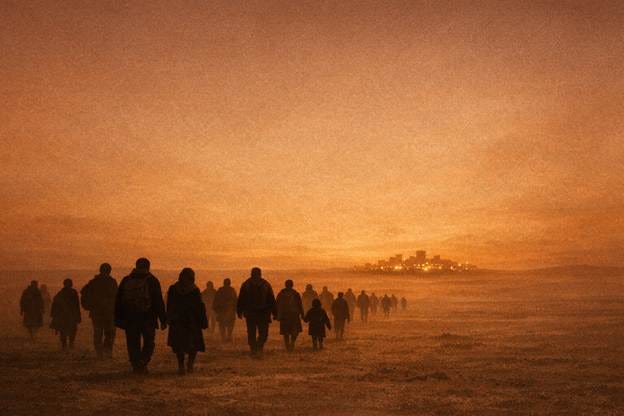
In 1939, a ship called the MS St. Louis left Hamburg carrying 937 Jewish refugees fleeing Nazi persecution. They had applied for visas. They had paperwork. Many had waited years. The United States turned them away. Cuba turned them away. Canada turned them away. The ship was forced to return to Europe. Of the 937 passengers, roughly 254 were eventually killed in the Holocaust.
Now jump to January 20, 2025. On his first day back in office, President Trump signed an executive order titled “Securing Our Borders,” which effectively halted legal asylum pathways that had been available for decades. Hundreds of thousands of migrants who had been waiting at the southern border for scheduled asylum appointments found those appointments cancelled overnight. They weren’t trying to sneak in. They had applied through official channels. They were waiting their turn. Then the rules were abruptly changed, leaving them with no practical recourse.
Two moments. Eighty-six years apart. The details differ. The outcome is the same: people who did what they were supposed to do, presenting themselves through legal or official channels, were turned away anyway. In one case, hundreds died as a result. In the other, we don’t yet know what happens to those hundreds of thousands of migrants.
This is the third piece in a series about people the Bible groups together as the particular objects of God’s concern. We started with prisoners, those ground up by a system that called itself legal. Then widows and orphans, those with no advocate, no voice, no one required to show up. Each group has surprised some readers. This one, I suspect, will be the most contested.
Because this one is about the immigrant. The foreigner. The person the Bible calls “the stranger.”
And if you’ve read the first two articles, you already know the pattern. The people God keeps naming are not random. They are, in every case, the people the surrounding system was most likely to exploit and least likely to protect. The immigrant and the foreigner fit that description so precisely that the Hebrew Bible addresses them more than almost any other group.
― ✶ ―
The Hebrew Word That Changes Everything
The last article introduced the ger, the resident foreigner, as one of the groups the Book of Deuteronomy pairs with the widow and orphan. It deserves more than a passing mention because the biblical treatment of the ger is one of the most extensive, most repeated, and most demanding sections of the entire Law of Moses.
The word ger (גֵּר) appears over 90 times in the Old Testament. It refers to a person living outside their homeland, without the family networks, land ownership, or legal standing that native Israelites enjoyed. They had no inherited property. No clan to advocate for them in a dispute. They were, by the structural logic of the ancient world, the people you could most easily take advantage of, and the people least likely to have any recourse if you did.
Which is why the Law built an entire safety net around them. It gave the ger the right to glean from the edges of harvested fields (Leviticus 19:9-10). Every three years, a communal tithe was collected and distributed to “the Levite, the foreigner, the fatherless and the widow” (Deuteronomy 14:28-29). Employers were prohibited from withholding their wages (Deuteronomy 24:14-15). The ger rested on the Sabbath. They had standing in court. Under the law, the same legal standard applied to the ger as to native Israelites.
This wasn’t charity. It was architecture. God built the care of the stranger into the structure of society, not as a virtue for generous people, but as a binding communal obligation.
When a foreigner resides among you in your land, do not mistreat them. The foreigner residing among you must be treated as your native-born.
Leviticus 19:33-34
The reason God gives for that command is important. Not because it’s the generous thing to do. Not because they deserve it. The reason is “for you were foreigners in Egypt” (Leviticus 19:34). You know this feeling. You lived it. Don’t forget what it’s like to be at the mercy of people who could treat you any way they chose and were never required to explain themselves.
― ✶ ―
A Theological Debate Worth Knowing
At this point I want to do what I’ve tried to do throughout this series; that is, be honest about where thoughtful people disagree.
Some serious biblical scholars, most prominently Professor James Hoffmeier of Trinity Evangelical Divinity School, argue that the Old Testament’s protective commands applied specifically to foreigners who had obtained legal permission to reside in Israel. Those who came through proper channels, so to speak. In his reading, the distinction between the ger (resident alien, protected) and the nekhar or zar (foreigner, fewer protections) maps roughly onto the modern distinction between legal and undocumented immigrants. The protective laws, he argues, apply to the former, not necessarily the latter.
It’s a serious argument. Here’s why I don’t find it finally persuasive.
First, the ancient world had nothing resembling a modern visa or passport system. Applying those categories backward onto the ancient Near East imports a bureaucratic framework that simply didn’t exist. The ger wasn’t someone who filed paperwork. They were someone who showed up, put down roots, became known, and came to be recognized as a resident. Their status was relational and communal, not documentary.
Second, scholars at Bible Odyssey, the academic biblical studies resource, note that the biblical category of stranger “includes those we would call immigrants, refugees, exiles, displaced persons, undocumented aliens, and temporary residents.” Not a subset of those. The whole range. Their reasoning: the text itself never restricts its concern to people who arrived by a particular process. What unites everyone that the word ger describes is not how they got there, but what their situation is once they are there. They are outside their homeland. They lack the family ties, land, and legal standing that protect everyone else. The laws responding to that situation are responding to a condition, not a credential. When the text says “do not mistreat the foreigner,” it identifies who qualifies by where they stand, not by what paperwork preceded their arrival.
Third, and most importantly: when Scripture explains why the ger deserves protection, it never appeals to their documentation. It appeals to their vulnerability. Their landlessness. Their kinlessness. Their exposure to exploitation with no recourse. Those are the defining characteristics. And those characteristics describe undocumented immigrants today more accurately than they describe someone who has successfully navigated a multi-year legal process.
The people who most closely match the biblical profile of the ger are not the ones who made it through the system. They’re the ones still waiting, still exposed, still without recourse.
None of this settles every policy question. The specific mechanics of immigration law, border management, and refugee processing involve genuinely complex tradeoffs on which faithful Christians disagree. I’m not equipped to resolve those debates, and this article isn’t trying to.
But those debates are about policy. What the Bible addresses is posture and people. And on that question, Scripture is neither quiet nor ambiguous.
― ✶ ―
How Many Times Does God Have to Say It?
The first article in this series observed that the prison population of Jesus’ day was full of debtors, dissidents, and the politically disposable. The second noted that “widows and orphans” wasn’t a demographic category so much as a diagnostic that named everyone without a human advocate in a world where your advocate was everything.
The stranger belongs to that same diagnostic. And the Bible makes this explicit, repeatedly grouping them together:
He defends the cause of the fatherless and the widow, and loves the foreigner residing among you, giving them food and clothing.
Deuteronomy 10:18
Cursed is anyone who withholds justice from the foreigner, the fatherless or the widow.
Deuteronomy 27:19
Do not oppress the widow or the fatherless, the foreigner or the poor.
Zechariah 7:10
The same cluster. Every time. The foreigner alongside the widow and orphan and the poor. Because the logic is the same. These are the people the system wasn’t built to protect, and the measure of a community’s faithfulness to God is how they treat them.
An old rabbinic tradition holds that the command to love the stranger appears in Torah 36 times, more than almost any other command. I can’t verify the precise count. But the frequency is real. This is not a theme the biblical writers stumbled across once. God kept returning to it. The prophets Jeremiah, Ezekiel, Isaiah, Amos, Malachi all press on it. Psalm 146 describes God himself as the one who “watches over the foreigner.”
At some point, the repetition is the argument.
― ✶ ―
The People Who Were Actually Moving
People moved in the ancient world for exactly the reasons they move today. Famine drove Jacob’s family into Egypt. Violence drove Abraham out of Ur. Persecution drove Moses into Midian. A murderous king’s decree drove Mary and Joseph out of Bethlehem and into Egypt with a newborn. War, drought, debt, the collapse of everything that had kept them alive where they were.
Migration was not comfortable or voluntary in most cases. The ger arrived with nothing. No property, no connections, no language advantage, no legal standing until the community granted it. They survived by working the edges of other people’s fields, by day labor, by the charity of strangers who themselves were not wealthy. They were among the most precarious people in the ancient world. Even before the flight to Egypt, Mary and Joseph showed up in Bethlehem as out-of-towners with no family connections and no resources to speak of—“no room at the inn.” They made do with a manger. The Son of God entered the world in the circumstances of the displaced.
And they were all, without exception, people with a story. A reason. A place they’d left and something they’d lost to get there.
The Bible’s own founding narrative is a migration story. The entire people of Israel defined themselves as former migrants, former slaves, former strangers. The Exodus wasn’t just their origin story. It was their theological framework for how to treat people who now stood where they had once stood.
― ✶ ―
The Uncomfortable Part About Jesus
The first article in this series referred to Matthew 25 (sheep and goats), where Jesus identifies himself with the prisoner, the sick, the hungry. What that article touched on briefly is worth expanding here: the stranger is on that list too. “I was a stranger and you invited me in.” (Matthew 25:35b)
Jesus doesn’t just teach about the stranger. He identifies with the stranger. Whatever framework we bring to immigration policy, that sentence sits in the middle of it and doesn’t move.
When the lawyer in Luke 10 asks Jesus to define “neighbor,” Jesus answers with the Parable of the Good Samaritan. The hero of that story is a foreigner, a racial and religious outsider, the kind of person a first-century Jewish audience would have found an uncomfortable choice. Jesus makes him the model of what love looks like. Not proximity. Not shared background. Not documentation. Love that crosses the road when it’s easier not to.
There is also the question of the Joseph, Mary and baby Jesus. Scholars debate the precise technical status of Jesus’ flight to Egypt as an infant. Since both Judea and Egypt were Roman territory, some argue the family never technically crossed an international border as we would define it. Others note that they fled at night from a murderous government, lived as foreigners in a land not their own, and returned only when the threat had passed. The technical debate may be real. But the experiential parallel is hard to dismiss.
Whatever framework we bring to immigration policy, “I was a stranger and you invited me in” sits in the middle of it and doesn’t move.
― ✶ ―
The Cost of Getting This Wrong
Back to the two examples that opened this article.
The passengers on the MS St. Louis were not abstractions. They were people with names, children, photographs in their pockets. They had done everything they were supposed to do. Nations that regarded themselves as civilized and, in many cases, Christian looked at them and turned away. Most of us know how that story ended, and we are not proud of it.
The hundreds of thousands of migrants whose asylum appointments were cancelled on January 20, 2025 are not abstractions either. They are people with names, children, reasons they left, things they are afraid to return to. Some fled gang violence. Some fled domestic abuse with no government protection available to them. Some fled political persecution. They weren’t trying to circumvent the system. They were using it. And it was shut down while they were in line.
I am not saying every immigration question has an obvious answer. I am not saying borders are illegitimate or that no policy distinctions can be made. But there are things happening right now that don’t require a policy degree to evaluate. Children being separated from their parents at the border and held in detention facilities. Brown-skinned American citizens being stopped, questioned, and in some cases deported because of how they look. People who applied for asylum in good faith being returned to the countries they fled, to face whatever they fled from. These are not edge cases or unintended consequences. And the Bible, which has quite a lot to say about the treatment of the foreigner, the vulnerable, and the person with no recourse, has something to say about them.
When we refuse to ask whose humanity is at stake, when we let the complexity of policy questions become an excuse to stop seeing the person, we have already made a choice. And it is not a choice the Bible would recognize as faithful.
The series has returned to this theme three times now. While the system tends to process people, faith tends to see them. The prisoner in article one. The widow and orphan in article two. The stranger here. The thread is not accidental. These are the people most likely to be ground down, and the people God most insistently names.
Micah asked what God requires. Jesus answered it in Matthew 25 (sheep and goats). The criteria weren’t theological precision. It was: did you show up? Did you see the person the system had already decided didn’t matter, and treat them like they did?
For the prisoner, that meant visiting.
For the widow and orphan, that meant being the advocate no one else was being.
For the stranger, it means something the Bible says more than almost anything else it says: Welcome them. Don’t mistreat them. Love them as you love yourself. Because you were a stranger once, whether you remember it or not. And God does not forget.
“The posture is not ambiguous. The stranger matters. Not because of their paperwork. Because of their humanity.”
For Further Reflection
God’s command to love the stranger is grounded in one thing: memory. “You were foreigners in Egypt.” What memory of displacement, of being outside, of depending on a stranger’s goodwill, do you carry? And what would it mean to let that memory shape how you see the stranger in front of you now?
This is Part 3 of a three part series on the people God notices, names, and calls us to care for. Part 1 is on visiting the prisoner, the discarded in “Prison Ministry Wasn’t the Point.” And Part 2 is on stepping forward for widows and orphans in “Unrepresented.”
Oh my goodness Harvey. This brought me to tears. Beautifully written and true to God’s loving heart. Thank you.
Important and appreciated posts!