


August is International Peace Month. It was created to remind us that peace doesn't just happen. Peace has to be chosen and fought for. “Fight Like Jesus” by Jason Porterfield makes the case that Jesus showed us his own way to do just that. Here's my review of that book and what it stirred up in me.
Visit Jason Porterfield’s website to learn more and find purchase options.
Having grown up in church, I have heard the Palm Sunday sermons, the Good Friday reflections, the Easter morning celebrations. I thought I had a pretty solid grip on Holy Week, the eight days from Jesus’ triumphal entry into Jerusalem to his resurrection, at least until I read Fight Like Jesus: How Jesus Waged Peace Throughout Holy Week by Jason Porterfield.
The whole book runs on one question: What if Jesus had a coherent strategy for making peace, and we’ve mostly missed it?
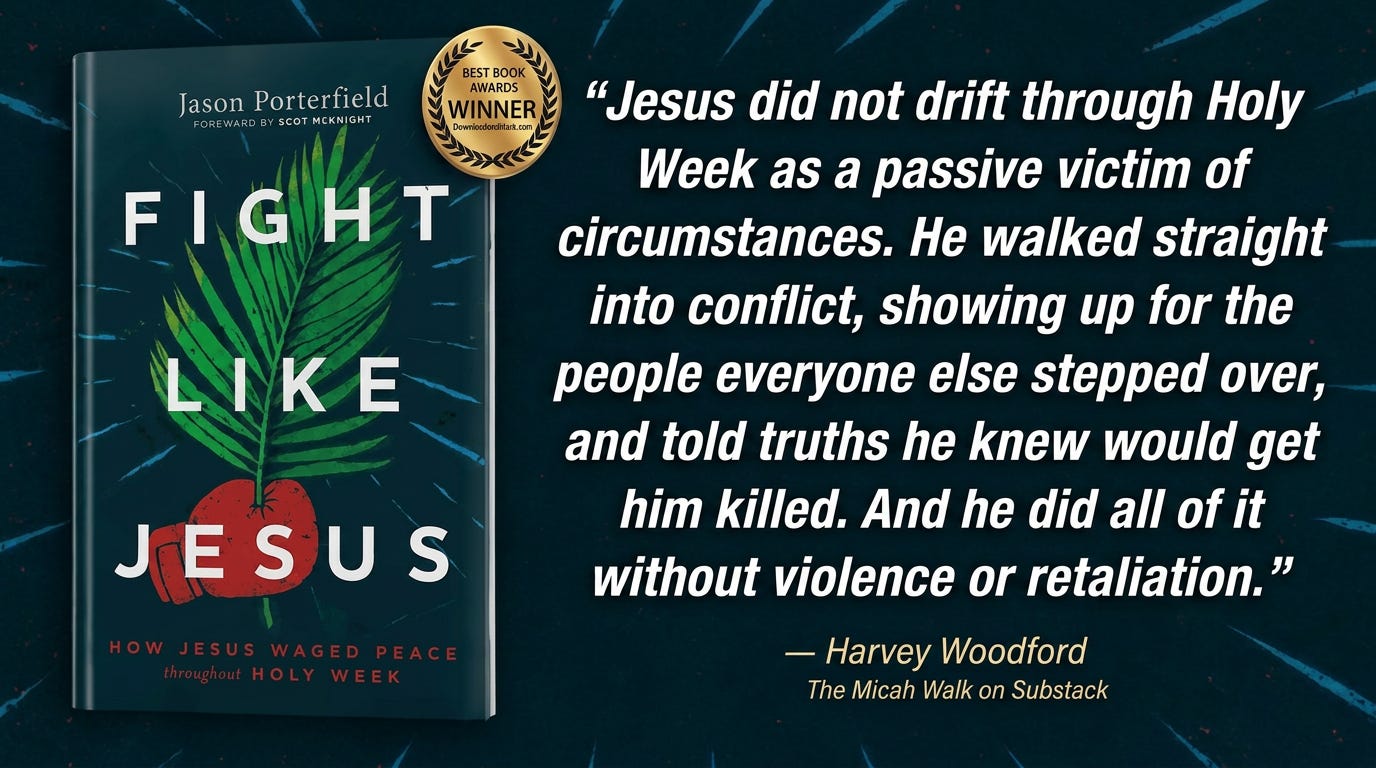
The central argument is that Jesus did not drift through Holy Week as a passive victim of circumstances. He walked straight into conflict, showing up for the people everyone else stepped over, and told truths he knew would get him killed. And he did all of it without violence or retaliation.
Porterfield structured Fight Like Jesus to be read during Lent, one chapter per week, tracking each day from Palm Sunday through Easter. In reality, it not a Lent-only book. The questions it raises about peacemaking, resistance, and the nature of power are not seasonal ones. It will hit you whether you read it in July, October or any darn month.
Here is a partial list of things I thought I understood that this book quietly rearranged for me:
• Jesus chose to ride into Jerusalem on Palm Sunday on a donkey as a theological statement (really, the donkey was his choice?).
• When the crowd waved palms and shouted “Hosanna,” they were invoking a symbol loaded with military and nationalist meaning, drawn straight from the Maccabean revolt.
• Jesus clearing the Temple courts was a calculated, nonviolent act of advocacy for a group of people I never would have guessed (who do you think he cleared it for?).
• There is a direct literary connection between the Beatitudes in the Sermon on the Mount and the Seven Woes Jesus pronounced against the religious leaders in Matthew 23. These two passages bookend Jesus’ public ministry, and reading them alongside each other changed how I hear both. Do you know the connection?
• I was wrong about Barrabas. After Porterfield provided the historical context, I uncomfortably admit that I am not as certain as I used to be that I would have chosen to free Jesus over Barrabas the muderer.
• The early church, directly shaped by Jesus’ teaching and example throughout Holy Week, has not produced a single recorded instance in the first century of Christians accepting or advocating violence as a legitimate tool for resisting injustice. Really?
• Porterfield’s treatment of Holy Saturday, the day Jesus lay in the tomb while his disciples sat in grief and confusion, is quietly powerful.
• Forgiveness is an actual superpower. Read the book to discover why.
I had the privilege of joining a Q&A session with Porterfield after reading the book. You can tell within about five minutes that he is not performing a position. Porterfield is a theological scholar, yes, and a genuinely gifted writer; but he is also someone who has organized his actual life around the people Scripture keeps pointing to—the poor, the unrepresented and the imprisoned. Those are ones we tend to walk past on our way to something more comfortable. Porterfield advocates for the marginalized by showing up with energy, with presence, and with his actual time.
I will tell you what the book did to me, practically speaking, because that is the most honest review I can offer. I brought it to my home Bible study group and we spent back-to-back meetings working through it together using the discussion questions in the back of the book. I separately gave copies into the hands of a half dozen church leaders I respect, with a strong personal recommendation to read it. I also bought a small stack of extra copies to give away as I have opportunity in the coming months. I am not a person who does that with books, but was compelled to do it after reading Fight Like Jesus.
This book will leave you asking what you are doing with you know and where you are moving toward conflict rather than away from it. And who are the people in your community whose woes I have been too comfortable to hear?
Fight Like Jesus: How Jesus Waged Peace Throughout Holy Week by Jason Porterfield is published by Herald Press (2022). It includes discussion questions for group use and works well as a small group study. Highly recommended.
Excellent read. So insightful. A book to be read again & again & to be lived out as a disciple of our Lord. Your review Harvey is spot on. Thank you brother.