


The book of Zephaniah opens with God threatening to undo creation.
Not metaphorically. Not as rhetorical flourish. The first three verses describe God sweeping away humans, animals, birds, and fish. It sounds like creation being unwound—Genesis in reverse. What God made in six days, he threatens to unmake entirely. It is, by any measure, a terrifying opening.
The book only gets harder from there. Corrupt judges. Bribed priests. Leaders described as roaring lions and evening wolves. An entire society that had mastered the art of religious performance while grinding the poor into dust underneath it. Zephaniah was writing into seventh-century BC Jerusalem, a city flush with wealth built on exploitation, temples full on Sabbath; courts rigged the other six days of the week. A city that had learned to say all the right things while doing all the wrong ones.
Sound familiar? Sure it does. That’s why the prophets keep getting read.
And then, at the very end of this ferocious, unsparing book, Zephaniah says:
“The Lord your God is with you, the Mighty Warrior who saves. He will take great delight in you; in his love he will no longer rebuke you, but will rejoice over you with singing.” (Zephaniah 3:17, NIV)
God. Singing.
Imagine that.
—— ✶ ——

The Song Has Been Going Longer Than You Think
Before we get to what God is singing, and who he’s singing over, it’s worth stepping back to ask a prior question: where did the singing start?
The answer is the beginning.
In Job 38, God speaks from the whirlwind and asks Job a series of questions designed to reorient his understanding of reality. One of them stands out:
“Where were you when I laid the earth’s foundation… while the morning stars sang together and all the angels shouted for joy?” (Job 38:4, 7, NIV)
Creation was accompanied by song. Not silence. Not a divine memo. Song. The cosmos was inaugurated in music, and the music has apparently never fully stopped. There was singing before there were humans to hear it. There was praise before there was anyone to organize a worship service.
So, if singing is woven into the fabric of creation itself, what does it mean that God joins in?
—— ✶ ——
Before the Song, the Silence It Breaks
Back to Zephaniah. To feel the full weight of verse 17, you have to understand who it’s for and who it isn’t for.
This was not a general announcement broadcast to everyone in Jerusalem equally. Just before the singing verse, God identifies precisely who receives the song. He describes in verse 12 leaving behind “a meek and humble” people, described with the Hebrew word “ani.” The afflicted. The poor. The ones bent under the weight of circumstances they didn’t create and couldn’t escape. The meek, as Jesus would later call them in the Beatitudes. The ones who kept faith while the powerful kept score.
The proud? Gone. The corrupt officials and their religious cover? Swept away. The people who built fortunes on someone else’s suffering? This song is not for them.
God sings over the remnant. Over the left-behind. Over the people the system had already decided didn’t matter much.
That is not incidental. That is the entire theological point.
Every major prophet carries some version of this same stubborn conviction: God’s deepest orientation runs toward the people the powerful overlook. Micah says it. Amos says it. Isaiah says it. And here, at the end of one of the darkest books in the Bible, Zephaniah says it with a song. God’s justice and God’s joy are not two separate things. They land in the same place, over the same people, at the same time.
The God who demands justice for the poor is the same God who sings with overflowing delight over the poor. That’s not a coincidence. That’s a portrait.
What Kind of Song Is This?
The Hebrew word behind “singing” in verse 17 is rinah. It appears throughout the Old Testament in contexts of harvest celebration, military victory, and worship that can no longer stay contained. This is not a lullaby. It is not ambient background music piped into a waiting room. Rinah is the kind of singing that happens when something so good has occurred that quiet is simply no longer an option.
God isn’t offering polite applause for the people who survived. He is erupting in harvest-joy over them. The same joy a farmer feels watching a field come in after a long drought. The same sound a crowd makes when the underdog wins.
And consider what that means in context. These are the ani—the poor, the afflicted, the ones the powerful spent generations ignoring. They are the occasion of God’s overflowing, can’t-keep-it-in celebration. Not despite what they’ve been through. But because of whose they are.
If that doesn’t reorient your theology a little, read it again.
—— ✶ ——
The Song That Wouldn’t Stop
The creation song in Job. God’s rinah over the broken remnant in Zephaniah. And then, centuries later, one more moment of divine singing. Quieter than the others, almost easy to miss, and perhaps the most tender of the three.
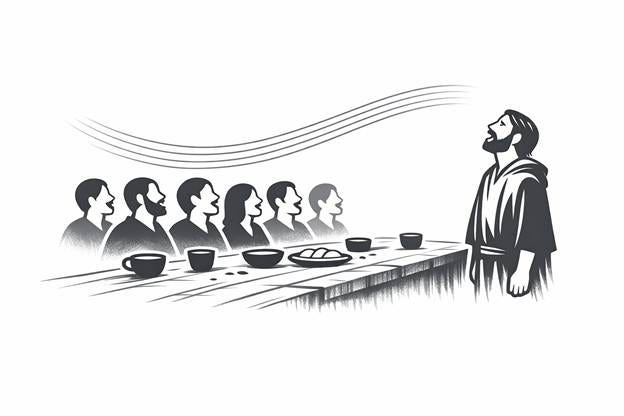
The Last Supper is ending. Jesus has just told his disciples that one of them will betray him, that Peter will deny him, that all of them will fall away before morning. He has broken bread and called it his body. He has poured wine and called it his blood. Everything he is about to walk through is already in full view. And then:
“When they had sung a hymn, they went out to the Mount of Olives.” (Matthew 26:30, NIV)
They sang. Jesus sang. Hours before Gethsemane. Hours before the arrest. Hours before the cross.
The hymn was likely from the Hallel (Psalms 113 through 118), sung by Jewish families at Passover for centuries. Psalms of trust and deliverance and steadfast love. As the head of the table, Jesus would have led the singing, the disciples responding in the ancient call-and-response pattern. He sang the promises of God over his disciples while walking directly into the most devastating night of his life.
There is also a verse in Hebrews 2:12 where the writer applies Psalm 22 to Jesus: “I will declare your name to my brothers and sisters; in the assembly I will sing your praises.” The Messiah is not just the subject of worship. He is a worshiper. He sings alongside us, not only over us. He is in the congregation, voice raised with everyone else’s.
Singing at the edge of the worst night imaginable. Singing alongside broken, frightened people who are about to scatter. If Zephaniah shows us a God who sings over the left-behind, Matthew shows us a God who sings with the left-behind, even when, and especially when, everything is about to fall apart.
—— ✶ ——
So What Does Any of This Mean for You?
Here is the personal question: if God’s song is specifically, stubbornly, consistently directed toward the broken, the humble, the overlooked, what does that do to you?
Two things, at least. It reorients you in one of two directions: comfort if you’ve been left-behind, and confrontation if you’ve been comfortable.
First, if you have ever felt like a left-behind, passed over, pushed to the margins by systems or people or just the relentless arithmetic of a world that rewards the loud and the powerful, then this verse is for you in a way that is not metaphorical. You are not the background of someone else’s story. You are the one God is singing over. With rinah. With harvest-joy. With the kind of delight that simply cannot stay quiet.
Second, if you are honest about the times you have been on the other side of that equation, when you had the power or the platform or simply the comfort of not being the one bearing the cost, then this verse is a mirror. God’s face is turned toward the ani. The question is whether yours is as well.
Justice, in the light of Zephaniah 3:17, is not merely a moral obligation to do right by people. It is an act of orientation. God is already leaning toward the meek. The question is whether we are leaning with him, or leaning the other direction and hoping he doesn’t notice.
Also, there is something in the image of Jesus singing at the Last Supper that speaks directly to the moments when faithful presence feels impossible. When the situation is bleak, the people around you are frightened, and there is no good outcome clearly in view. He sang anyway. Not as denial. Not as performance. As an act of trust so deep it came out as music.
That’s worth something on the hard days.
—— ✶ ——
The Song Hasn’t Ended
The stars sang at the beginning. God erupted in harvest-joy over the broken remnant in the middle of history. Jesus lifted his voice in the upper room hours before the cross.
The same thread runs through all of it. God has never been silent when it mattered most. And the people he sings over, sings alongside, sings into—they are never the ones with the most power in the room. They are the ones the room forgot.
That is not a peripheral theme in Scripture. It is close to the center of it.
Zephaniah leaves us with one question that hasn’t expired in twenty-seven centuries. The song is still going. The invitation is still open.
Are you listening? And are you singing back?
God doesn’t reserve his loudest joy for the powerful. He sings his harvest-song over the people the harvest forgot. If his deepest delight runs toward the broken and overlooked, the only real question is whether ours does too.
For Further Reflection
The God who demands justice for the overlooked is the same God who sings with overflowing joy over the overlooked. If those two things belong together in God, where do they belong together in you? What would it look like this week to lean in the direction God’s face is already turned?
Wow. This is beautiful, Harvey! And such a helpful reminder about how to orient ourselves. I have felt God pulling me away from being constantly oriented to anger at those in power doing terrible things, to face instead those on the margins and find what is mine to do.
Yes so beautiful Harvey! And Caity Gill thank you for sharing your experience!
Harvey as I was reading your Substack tears welled up in my eyes & my heart was singing God’s praises. Thank you